
My Evolution
Visual design →
My early career in visual design taught me how to communicate clearly under tight constraints like time, brand, budget, and attention.
Designing and iterating quickly under real deadlinesMaking ideas legible to non-designers
Using hierarchy, typography, and composition to guide understanding
Balancing creativity with practical constraints
Working across fashion, architecture, and non profits exposed me early to very different audiences and expectations .
Communications →
In communications roles, I learned how complex information breaks down, and how easily meaning gets lost between experts, stakeholders, and the public.
Translating dense, technical, or high-stakes information into usable narratives
Designing for diverse audiences with competing needs
Aligning multiple teams around a shared language and visual system
Seeing communication breakdowns as system failures, not people failures
Whether it was disaster-recovery data, policy reports, or multi-office brand systems, the challenge was always the same: clarity at scale.
UX / Product Design
UX and product design brought everything together: research, systems thinking, visual clarity, and a deep respect for real-world constraints.
Research-driven design grounded in real workflows and mental models
Comfort operating in ambiguity and high-stakes environments
Designing internal tools where accuracy, scale, and trust matter as much as usability
Partnering closely with engineering and stakeholders to surface complexity early
My earlier roles taught me how people think, how systems fail, and how clarity gets lost. Product design is where I learned how to fix it.
Evidence of impact
Trusted by cross-functional partners to bring clarity to complex systems.

Jamie is a natural leader who fosters collaboration and helps teams do their best work. She brought structure to complex requirements, balancing partner needs with user goals while keeping the process focused and adaptable.
Team Member - Capstone Project for UCI Masters Program
Embedding Jamie as a UX designer was critical to the success of Bequest Central. She brought clarity and structure by translating complex business needs into intuitive Figma wireframes that became the blueprint for development and stakeholder alignment, helping us define scope early and avoid costly rework.
Team Member - Solutions Architect
This project had stalled for over three years before Jamie joined. She immediately bridged gaps between our legal team, the vendor, and IT, and her Figma designs changed everything — helping us understand what was possible and move forward with confidence.
Customer- Legal Team
HOW I WORK
I partner early and often with engineering.
Close collaboration helps surface complexity sooner, align on feasibility, and reduce the risk of costly rework later.
I design for scalability, not just MVPs.
I consider long-term maintainability, data integrity, and organizational impact from the start.
I balance user needs with organizational reality.
The most effective solutions work for users and for the systems that support them, including process, policy, and technology.
I take ownership in ambiguous environments.
When problems are unclear or stalled, I step in to create momentum by learning what is needed, finding the right partners, and navigating complexity to move the work forward.
Design Philosophy
PERSPECTIVE
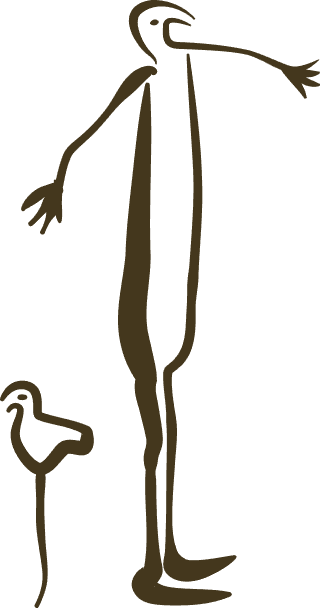
The “Birdman” is the only human figure found among the ancient cave paintings of Lascaux Cave Paintings. Part human and part bird, the figure has long been interpreted as a symbol of guidance, transformation, and movement between worlds.
I first encountered these paintings in a high school French class, and they sparked a lasting interest in anthropology and humanity’s shared history. What stayed with me was not a single meaning, but the reminder that across time and complexity, people are still trying to understand themselves and one another.
This illustration represents how I see my role as a designer. I aim to rise just enough above the chaos to see patterns clearly, stay grounded in empathy, and remain focused on the humans inside the system.